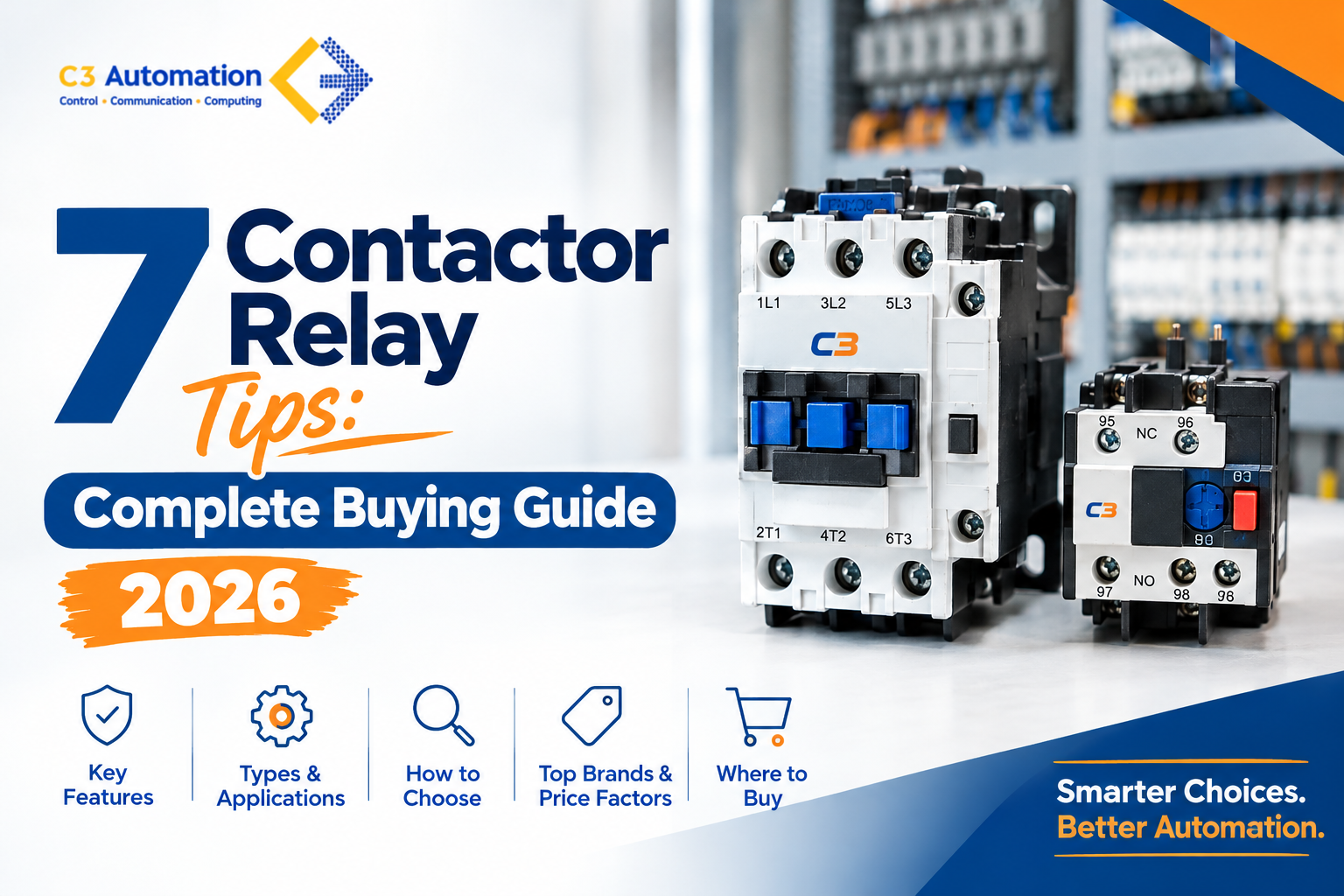
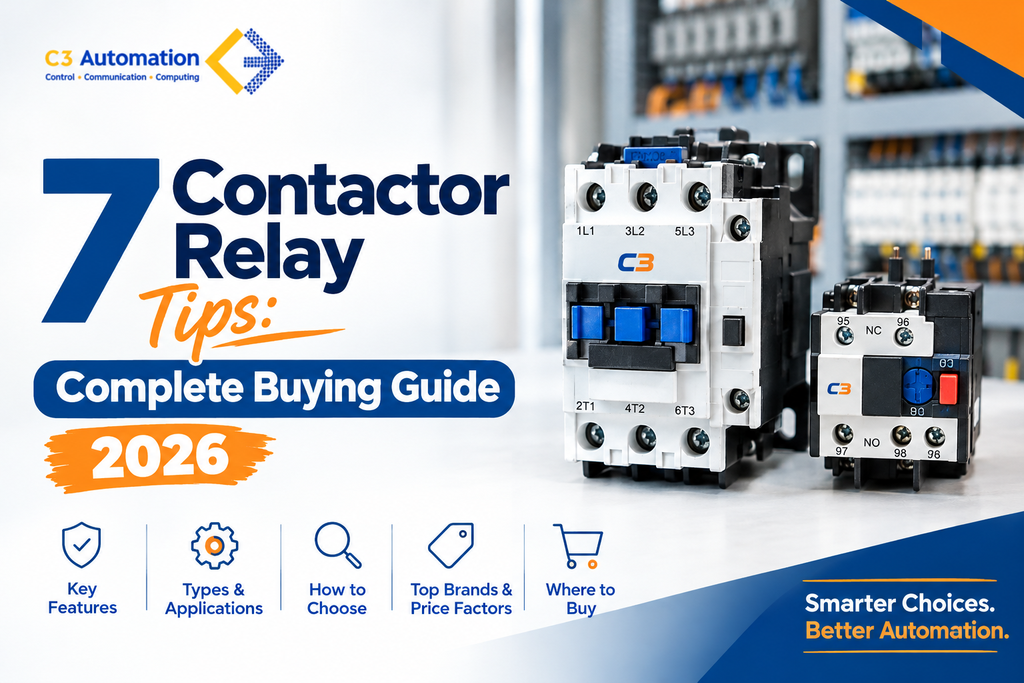
If you’ve ever had a control panel go down because someone specced the wrong switching component, you already know why this decision matters more than it looks. A contactor relay is a small part on paper, but it sits right at the point where your control signal meets your actual load — and if it’s undersized, mismatched, or just poor quality, that’s usually where the failure shows up first. At C3 Automation, we’ve supplied and supported contactor relays across industrial panels, HVAC installations, and automotive systems for years, and the questions we get from customers tend to repeat themselves: What coil voltage do I need? Is this rated for my motor? What’s actually the difference between a contactor and a relay? This guide answers those questions directly, based on the same things we walk customers through before they buy. Below are 7 practical tips — covering everything from coil voltage to picking a supplier you can actually trust.
What Is a Contactor Relay?
A contactor relay is an electrically controlled switch used to turn circuits on and off — but unlike a small signal relay, it’s built to handle higher current loads safely. It works on a simple principle: a control signal energizes a coil, the coil generates a magnetic field, and that field pulls a set of contacts together (or apart) to control power flow to a motor, compressor, heater, or lighting bank. The reason this matters in practice is that a contactor relay lets you control something powerful — say, a 5HP motor — using a low-power control signal from a PLC or push button, without ever putting that heavy current through your control wiring. That’s the whole point of the design, and it’s why contactor relays are the standard choice across industrial automation, HVAC, and motor control systems.
Tip 1: Understand How a Contactor Relay Works Before You Spec One
It sounds basic, but skipping this step is where a lot of buying mistakes start. A contactor relay has three core parts: the coil, the contact set, and the housing/frame that holds everything together and provides insulation. When you apply the rated voltage to the coil, it pulls the contacts into position, completing the circuit to your load. Release the voltage, and a spring mechanism pulls the contacts back open. It’s a mechanical process, which means wear is real — contacts do degrade over time, especially under frequent switching or inductive loads like motors. Knowing this upfront helps you ask the right questions when comparing products, like expected mechanical and electrical life cycles, rather than just looking at the price tag.
Tip 2: Choose the Right Coil Voltage for Your Control Circuit
This is the single most common spec mismatch we see. The coil voltage has nothing to do with the load you’re switching — it’s about what your control circuit is already running on.
12V Contactor Relay — When to Use It
A 12v contactor relay is the right call when your control circuit runs directly off a 12V DC supply — think automotive systems, solar charge controllers, marine electronics, or small battery-powered equipment. If you try to run a 12V coil from a 24V or 220V control circuit, you’ll either burn out the coil or it simply won’t hold — there’s no in-between. For industrial control panels, 24V DC and 220V/240V AC coils are far more common, since they match the standard control voltages used across most PLC-based systems. Before you order, check the wiring diagram or existing panel voltage rather than assuming — this five-minute check saves a return shipment later.
Tip 3: Match Load Current and Voltage Rating to the Actual Load
Every contactor relay carries a rating for maximum current and voltage it can safely switch, and this is where “close enough” gets expensive. Look for three numbers on the datasheet In our experience, undersizing is the most common and most costly mistake customers make. A contactor rated too close to the actual running current will run hot, and over months that heat accelerates contact wear until you get pitting, welding, or outright failure — usually at the worst possible time. A safe rule of thumb is to size for at least 25% above your expected continuous load current, and more if the load has heavy inrush current like a motor start.
- Rated operational current (Ie) — the continuous current the contacts are built to carry
- Rated operational voltage (Ue) — the maximum voltage the contacts are rated to switch
- Utilization category — AC-3 for motor loads with inrush current, AC-1 for simple resistive loads like heaters
Tip 4: Know Whether You Need AC or DC Switching
Not every contactor relay handles AC and DC equally well, and this trips people up more than you’d expect. AC current naturally crosses zero twice per cycle, which helps extinguish the arc as the contacts open. DC current doesn’t have that natural zero-crossing, so a contactor built for DC switching needs additional arc-suppression design — otherwise the arc can sustain itself and damage the contacts. If your project spans both — say, a solar system with a DC battery bank feeding an AC inverter load — make sure you’re specifying the correct contactor for each side rather than assuming one part will cover both.
Typical applications break down like this:
- Industrial control panels — motor starters, conveyor drives, pump control
- Automotive and DC systems — starter motors, winches, auxiliary battery banks
- HVAC systems — compressor contactors, condenser fan motor control
Tip 5: Understand How Electrical Contactors and Relays Actually Differ
The line between electrical contactors and relays gets blurry for a lot of buyers, partly because they look similar and work on the same magnetic principle. But they’re built for different jobs, and using one where the other belongs is a common source of underperformance.
| Feature | Contactor | Relay |
| Switching Capacity | High current — motors, heavy loads | Low to medium current — signals, small loads |
| Typical Use | Industrial motors, HVAC, lighting banks | Control logic, signaling, small appliances |
| Contact Rating | Usually 9A and above | Usually under 10A |
| Arc Suppression | Built-in arc chutes or suppression design | Minimal to none |
| Physical Size | Larger, heavier duty housing | Compact |
As a general guide: if you’re switching anything with a motor, compressor, or heavy inductive load, you want a contactor. If you’re dealing with control logic, sensor signals, or small loads under 10A, a standard relay is usually the more cost-effective and appropriately-sized choice.
Tip 6: Check Mounting Type, Build Quality, and Certifications
Two contactor relays can share identical electrical specs on paper and still perform very differently in the field — and mounting and build quality are usually why. Beyond mounting, look at the IP rating for dust and moisture protection, relevant certifications (CE, UL, or regional equivalents), and contact material — silver alloy contacts generally resist pitting and last longer under repeated switching than plain copper. If a datasheet doesn’t list certifications or contact material at all, that’s usually worth a follow-up question before you buy.
Common mounting styles include:
- DIN rail mount — the standard in most modern control panels, quick to install and swap out
- Panel or surface mount — used where DIN rail isn’t practical, often in custom enclosures
- Base or screw mount — still common in older or heavy-duty industrial installations
Beyond mounting, look at the IP rating for dust and moisture protection, relevant certifications (CE, UL, or regional equivalents), and contact material — silver alloy contacts generally resist pitting and last longer under repeated switching than plain copper. If a datasheet doesn’t list certifications or contact material at all, that’s usually worth a follow-up question before you buy.
Tip 7: Buy From a Supplier That Can Back Up What They Sell
You can spec everything perfectly and still end up with a bad result if the unit itself is a low-quality clone or mislabeled part — and unfortunately, this happens more often in this category than buyers expect. Before ordering, check for This is really the difference between a contactor relay that performs to its rated spec for years, and one that fails within months under the same conditions. A trustworthy supplier — one that stands behind what they sell and can answer technical questions with real depth — is worth more than a marginally lower price.
- Genuine, certified products with manufacturer documentation you can actually verify
- Warranty coverage, so you’re not absorbing the cost of an early failure
- Technical support from people who can help with sizing, not just order-taking
- Reliable stock availability, so replacements are easy to source when you need them later, not three months from now
FAQs
1. What is the difference between a contactor and a relay?
A contactor is built to switch higher current loads, like motors and industrial equipment, and includes arc-suppression design for that job. A relay is typically used for lower current signaling and control logic, and doesn’t need the same level of built-in arc protection.
2. What is a 12V contactor relay used for?
A 12V contactor relay is most often used in automotive systems, solar power setups, marine electronics, and other low-voltage DC control circuits where the coil needs to match a 12V battery or power supply.
3. How do I test a contactor relay?
Use a multimeter to check coil resistance first, then apply the rated coil voltage and confirm the contacts close (or open) correctly while checking continuity across the contact terminals. Any unusual resistance, arcing, or failure to engage points to a coil or contact problem.
4. Can a contactor relay be used for both AC and DC applications?
Some are rated for both, but many contactor relays are designed specifically for one due to differences in how they suppress arcing. Always check the datasheet rating before assuming a unit works across both current types.
5. How do I choose the right coil voltage for a contactor relay?
Match the coil voltage to your existing control circuit’s supply — commonly 12V DC, 24V DC, or 220V/240V AC — rather than the voltage of the load you’re switching. Using a mismatched coil voltage will either prevent proper operation or damage the coil outright.
Conclusion
Picking the right contactor relay isn’t complicated once you know what to check — but skipping any one of these steps is usually how a good panel turns into a support call six months later. Start with the basics: match the coil voltage to your control circuit, size the contacts for your actual load with a safety margin, and confirm whether you need AC or DC switching before you order anything. From there, it’s about the details that don’t always show up on a spec sheet — build quality, certifications, and whether the supplier actually stands behind what they sell.
None of these steps take long individually, but together they’re the difference between a contactor relay that runs quietly for years and one that fails at the worst possible time. If you’re still unsure which option fits your setup, it’s worth a quick conversation with a supplier before you commit to an order.