Choosing the right media converter fiber to ethernet device isn’t as simple as picking the first product that shows up in a search. Get it wrong, and you end up with dropped links, bottlenecked speeds, or hardware that fails within months in a hot server room or an outdoor cabinet. Get it right, and you’ve built a network bridge that runs quietly for years without a second thought.
If you’re new to the topic and want a plain-language introduction first, we’ve already covered what a media converter is and how it works and the core uses of a media converter in earlier posts. This guide picks up where those leave off — it’s built specifically to help you choose the right device, not just understand what one does.
Below are the eight factors that actually matter when you’re evaluating a fiber-to-ethernet converter for a real project, plus the mistakes we see buyers make most often in the UAE market.
Why the Right Media Converter Fiber to Ethernet Choice Matters
A poorly matched fiber optic media converter doesn’t just underperform — it can become the single weak point in an otherwise solid network. Mismatched fiber modes, wrong distance ratings, or non-industrial hardware installed in a harsh plant environment are among the top reasons converters fail early. Since an ethernet media converter is often installed once and left running for years, spending a few extra minutes on the buying decision upfront saves far more time (and downtime) later.
A real-world example: We were once called in to troubleshoot repeated link drops on a fiber run connecting a remote pump station to a plant’s main control room in an outdoor UAE industrial site. The converter installed was a commercial-grade unit rated for standard office use, not the ambient temperatures inside a sun-exposed equipment cabinet. Once daytime temperatures pushed past the unit’s rated operating range, the link would intermittently fail, causing SCADA communication dropouts. Swapping in an industrial-grade converter rated for -40°C to 75°C operation resolved the issue permanently. The lesson: the cheapest converter that “works in testing” isn’t the same as one that survives the actual installation environment.
1. Ethernet Speed Requirements: Fast Ethernet vs Gigabit
The first decision in any fiber-to-ethernet converter purchase is speed. Most ethernet media converter models fall into one of two categories:
- 10/100 Mbps (Fast Ethernet) — sufficient for basic sensors, older PLCs, and low-bandwidth monitoring devices.
- 10/100/1000 Mbps (Gigabit Ethernet) — the safer choice for modern SCADA systems, IP cameras, and any network expected to grow.
If there’s any chance your bandwidth needs will increase, choose a Gigabit-capable media converter even if your current devices don’t need it yet. Retrofitting later usually costs more than paying the small premium now.
2. Single-Mode vs Multi-Mode Fiber
This is one of the most common points of confusion when buying a fiber-to-ethernet converter. The fiber type on your converter must match the fiber type on both the cable and the device at the other end.
| Factor | Multi-Mode Fiber | Single-Mode Fiber |
| Typical distance | Up to ~2 km | Up to 40 km+ (with the right SFP module) |
| Cost | Lower cost | Higher cost |
| Best suited for | Shorter, in-building or short-campus runs | Long-distance or site-to-site links |
| Long-term flexibility | Limited for future expansion | Better suited to growing network reach |
Always confirm the fiber type before ordering — a mismatched device simply won’t establish a link, no matter how well everything else is configured.
3. Transmission Distance
Copper Ethernet is capped at 100 meters under the TIA/EIA-568 structured cabling standard. That limitation is the entire reason a fiber media converter exists in the first place — it lets you extend that connection using fiber, which can run anywhere from a few hundred meters to over 80 kilometers depending on the module and fiber type.
Before buying, map out the actual distance your fiber run needs to cover. Buying a converter rated for far more distance than you need isn’t wrong, but underestimating distance is a common — and costly — mistake.
4. Managed vs Unmanaged Media Converter
| Factor | Unmanaged Converter | Managed Converter |
| Setup | Plug-and-play, no configuration | Requires initial configuration |
| Monitoring | None | SNMP monitoring, remote diagnostics |
| Advanced features | Basic link only | VLAN tagging, fault alerts |
| Best suited for | Simple point-to-point links | Larger networks needing centralized visibility |
| Relative cost | Lower | Higher |
For a single, non-critical connection, an unmanaged converter is usually enough. For anything tied to production uptime, the extra visibility of a managed unit is worth the cost.
5. Industrial-Grade Build and Temperature Rating
This is where many buyers cut corners — and pay for it later, as in the example above. Standard commercial-grade converters aren’t built for UAE conditions: high ambient heat, dust, vibration, and inconsistent power quality in industrial plants.
Look for:
- Wide operating temperature range — industrial-rated units commonly follow ranges similar to those defined for IEEE 802.3 industrial Ethernet applications, typically -40°C to 75°C
- DIN-rail mounting for panel installation
- Rugged metal housing (IP30 or better)
- Wide-range DC power input for compatibility with existing panel power supplies
An industrial-grade fiber-to-ethernet converter costs more upfront but avoids premature failure in factory, outdoor, or rooftop installations — environments where a consumer-grade converter simply won’t last.
6. Power over Ethernet (PoE) Support
If the converter needs to power a downstream device — an IP camera, wireless access point, or IoT sensor — you’ll need a media converter with PoE or PoE+ output. Not all fiber to ethernet converters support this, so confirm it explicitly rather than assuming it’s included.
7. Port Configuration and Connector Types
Check the physical connectors on both ends of the link:
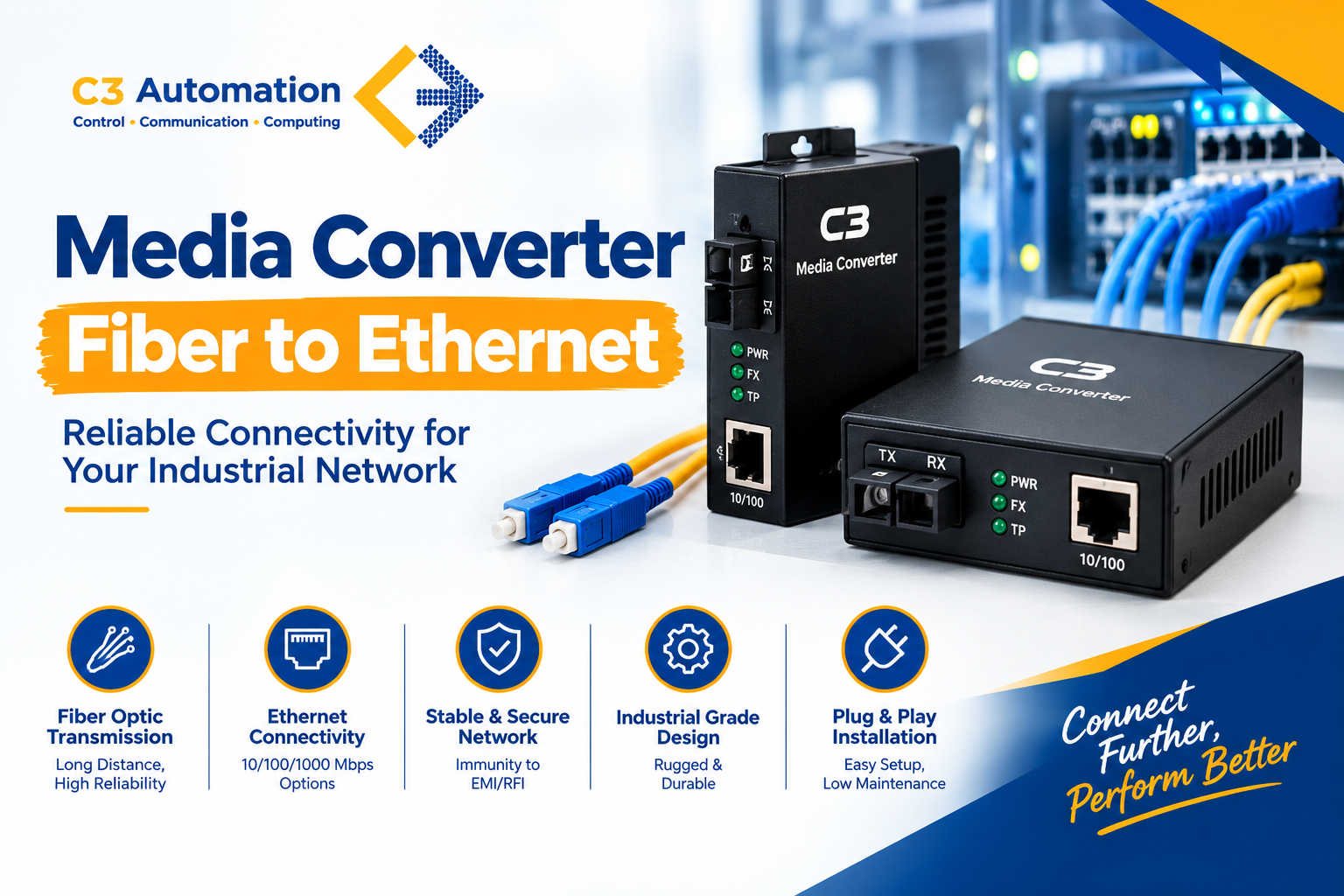
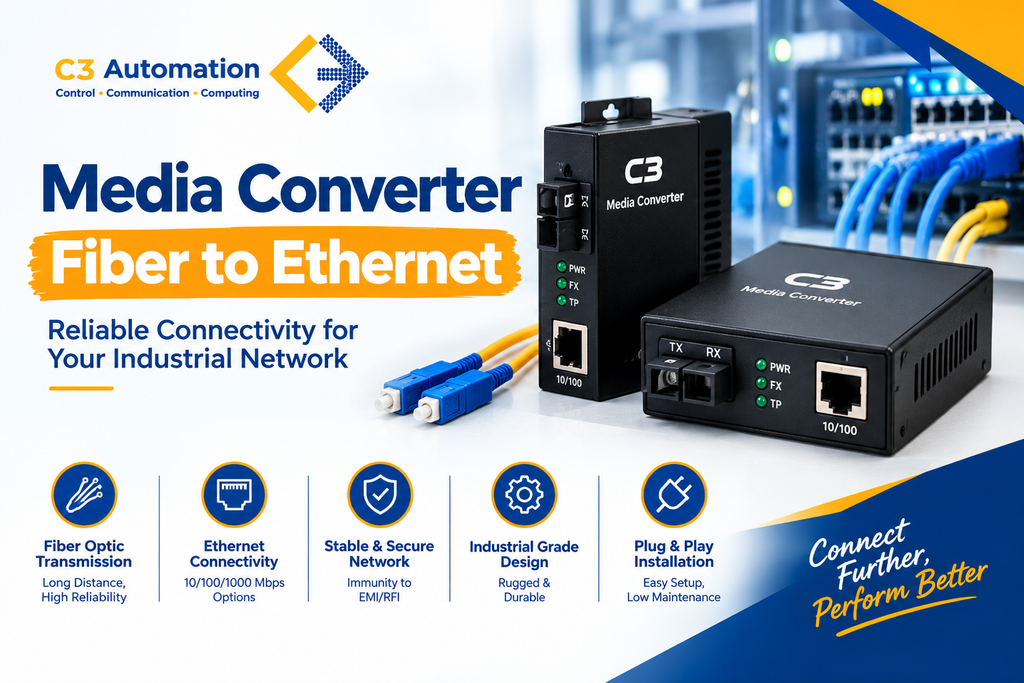
- RJ45 for the copper Ethernet side
- SC, LC, ST, or SFP slot for the fiber side
An SFP-slot design offers the most flexibility, since it lets you swap fiber modules later without replacing the entire unit. If your network specs might change, this flexibility is worth prioritizing.
8. Brand Reliability, Warranty, and Local Support
Not all media converters are built to the same standard. Established industrial networking brands generally offer better long-term reliability, wider operating specs, and more consistent firmware support than unbranded alternatives. Just as important in the UAE market is having a local supplier who can provide genuine stock, technical support, and warranty backing — rather than relying on imports with no local accountability if something fails.
Common Mistakes to Avoid When Buying a Fiber Optic Media Converter
- Ignoring fiber mode mismatch — beyond the connection simply failing, this often means a second shipping delay and downtime while the correct part is sourced, which can stall a project by days.
- Choosing consumer-grade hardware for an industrial environment — the upfront savings are usually erased by the cost of a site visit and replacement unit once the original fails, as in the pump station example above.
- Skipping PoE requirements — discovering post-installation that a downstream camera or sensor has no power source often means an unplanned second purchase and a repeat site visit.
- Overlooking after-sales support — buying the cheapest option with no local warranty backing leaves you without recourse if the unit fails outside a manufacturer’s standard return window.
Related Products
- Industrial Gigabit Fiber Media Converter
- Unmanaged Ethernet to Fiber Converter
- Managed SFP Media Converter with PoE
- DIN-Rail Mount Industrial Media Converter
Conclusion
Frequently Asked Questions
- What’s the difference between a media converter and a fiber media converter?
“Media converter” is the broader term for any device converting between two cable types. A “fiber media converter” specifically refers to converters that bridge copper Ethernet and fiber optic cabling — the most common type in industrial and enterprise networks.
- Can a single ethernet media converter handle both single-mode and multi-mode fiber?
Only if it uses a swappable SFP module — you’d need the correct module for whichever fiber type you’re connecting to. Fixed-port converters support only one fiber mode.
- Do I need a managed media converter for a small installation?
Not necessarily. For a single, non-critical link, an unmanaged converter is simpler and more cost-effective. Managed units make more sense for larger networks needing centralized monitoring.
- How long do industrial fiber to ethernet converters typically last?
With correct specification (matched fiber mode, appropriate temperature rating, and adequate power supply), industrial-grade units commonly run for 5–10 years with minimal maintenance.
- Is a fiber to ethernet converter the same as an SFP transceiver?
No. An SFP transceiver is just the small pluggable module inside the device that does the optical conversion, while a media converter is the complete standalone unit that connects a copper Ethernet device to a fiber network.