The difference between managed switch and unmanaged switch is a critical issue for anyone who is setting up or re-configuring an existing network. No matter if you are a company administrator, system integrator or an IT professional, selecting the right switch will affect the performance of your network security, scalability, and security. Although both types of switches can be used to connect various devices to networks, they differ in terms of the control features, capabilities, and control. Understanding the differences between them can aid you in making an informed choice based on your individual requirements. In this article, we go through the most important features of managed and unmanaged switch choices which will help you to pick the appropriate option for your office, home, or industrial set-up.
What is a Managed Switch?
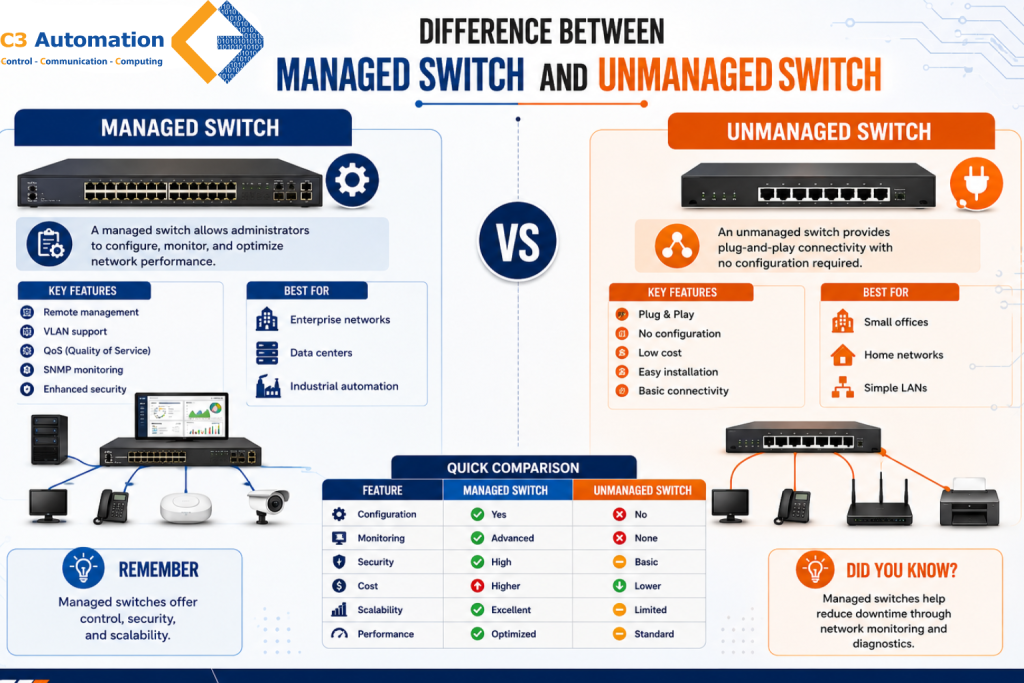
Managed switch is a sophisticated network device that gives you complete access to your networks. It permits administrators to set up and monitor the performance of their network efficiently.
With features such as VLAN support, as well as traffic prioritization and remote access managed switches are great for industrial and commercial environments. They help to optimize the network’s traffic, improve security, and facilitate communications between connected devices.
Managed switches are often employed in large-scale networks where reliability, performance, and security are essential.
Features of Managed Switch
To understand the value of managed switch and to better understand their value, here are a few key features of managed switches. These attributes make managed switches crucial for complex and modern networks.
- VLAN support for network segmentation
- Remote management capabilities
- Prioritization of traffic (QoS)
- SNMP monitoring to monitor performance
- Improved security controls
Advantages of Managed Switches
Managed switches offer a superior level of control and information in a network, which makes them perfect for large and expanding environments. They let administrators track performance, manage traffic efficiently, and resolve problems in real-time. With advanced options for configuration, they help improve bandwidth utilization and help to ensure the smooth operation of critical applications. They also provide more secure security features, which can reduce the possibility of unauthorised access. Overall controlled switches can be a safe option for businesses that need efficiency, flexibility, and scalability over the long term. The advantages include:
- Greater control over the network
- Better performance
- Security enhancing
- Better scalability
- Ideal for industrial automation
What is an Unmanaged Switch?
Unmanaged switches are simple plug-and play networking device. It does not require setting up and is automatically activated once connected.
These switches are ideal for small networks and home networks where sophisticated control isn’t required. They are simple to set up and affordable, which makes them an ideal option for the basic needs of networking.
Unmanaged switches aren’t equipped with advanced features that could hinder their performance in more complex environments.
Features of an Unmanaged Switch
Although simpler switches that are not managed still provide practical functions. They are great for basic networking requirements that do not require technical sophistication.
- Installation is simple and requires no set-up
- Affordable prices
- Connectivity that is reliable and basic
- Design that is user-friendly and compact.
Advantages of Unmanaged Switches
Unmanaged switches are needed for those who require an easy and simple network solution. They do not require any technical skills, which is why they are ideal for starters and smaller installations. These switches work automatically, and do not have the requirement for monitoring or configuration. They are affordable, which makes them an ideal option for users with limited budgets. Overall, they offer reliable basic connectivity to meet your everyday network requirements.
- Low cost
- Simple to use
- Quick set-up
- Ideal for smaller networks
Managed vs Unmanaged Switch: Key Differences Overview
Before we dive into the details for a deeper dive, here’s a quick glance into the managed and. unmanaged switch comparison:
- Managed switches provide advanced control and customized
- Unmanaged switches are simple to use and provide simplicity of use
- Managed switches provide monitoring of networks and security features.
- Unmanaged switches can be a good option for budget-conscious users, but they are they are limited
Now, let’s examine the six major differences between controlled switch and unsmanaged switches in depth.
1. Configuration and Control (Managed vs Unmanaged Switch)
One of the biggest distinctions between managed and unmanaged switches for networks is the degree of control. Managed switches permit administrators to modify network settings like VLANs, bandwidth allocation along with port setting. This control level ensures greater efficiency and optimization of networks. However managed switches do not provide any choices for configuration. They work automatically, without any configuration, which makes them perfect for networking with minimal requirements.
2. Performance and Traffic Management
In terms of efficiency, the managed switch have a distinct advantage. Managed switches facilitate traffic management by utilizing features such as Quality of Service (QoS). This makes sure that important data like the streaming of video or signal for automation is prioritized over traffic that is less important.
Unmanaged switches are not equipped with capability to manage traffic. This means that all data is treated the same which could lead to increased congestion and slower performance in busy networks.
3. Security Features
Security is yet another important factor that determines the difference between managed switch and unmanaged switch. Managed switches come with sophisticated security features like:
- Access Control Lists (ACLs)
- Security at ports
- Network monitoring
These tools help to secure your network from unauthorised access and cyber-attacks.
Unmanaged switches don’t have security features that are built-in, which makes them unsuitable for settings where the security of data is essential.
4. Cost and Budget Considerations
Cost is a key factor in deciding between a managed vs unmanaged switch. Unmanaged switches are cheaper and are ideal for small companies or homeowners with tight budgets. They offer basic functionality but without any additional features. Managed switches, though costlier, can provide longer-term benefits through improved performance, scalability, and security. For industrial and business applications, it is usually justifiable.
5. Scalability and Flexibility
Scalability is essential to grow networks. Managed switches are extremely flexible and easily adapt to growing network demands. They let administrators add new devices, build virtual networks and alter settings as required. Unmanaged switches have a limited capacity for scalability. They’re best suited to small-scale fixed networks in which expansion is not the primary concern.
6. Use Cases: When to Use Managed vs Unmanaged Switch
Knowing when to use which type of device is essential to make the right choice.
Use Managed Switch When:
- You’ll need control of your network and monitoring
- Your network handles high volume traffic
- Security is an important concern
- You manage enterprise or industrial systems.
Use Unmanaged Switch When:
- You’ll need a simple plug-andplay solution
- Your network is tiny and simple
- Budget is a major issue
- No configuration of any kind is required.
Managed vs Unmanaged Switch: Which One Should You Choose?
The choice between a managed vs unmanaged switch is largely based on the specific requirements of your network and the long-term objectives. If you are running an industrial, business, or a large network, an unmanaged switch is typically more suitable due to its sophisticated capabilities. It offers more control over the network’s traffic, improved security features, and the flexibility to grow as your needs increase. This makes it ideal in environments where reliability, performance, and monitoring are essential.
However, for those who live at home or small-sized offices with limited network requirements, an unmanaged switch can be a convenient and affordable option. It does not require setup, making it simple to set up and use without any technical knowledge. This plug-and-play feature is perfect for connectivity requirements that are basic and advanced features are not required.
In addition, the budget plays a significant part in the decision-making process. Although managed switches require an initial investment that is higher but they provide long-term benefits through increased performance and scaling. Unmanaged switches are less expensive initially and are suitable for applications that are simple applications.
In the end, your choice is determined by factors such as the size of your network, its complexity, security requirements, as well as the plans for expansion in the future. Examining these factors carefully will allow you to select the right switch for your network.
Related Products
- MCSESU083FNO Unmanaged Ethernet Switch – 8-Port DIN Rail | Modicon
- TCSESU053FN0 – ConneXium 5-Port Unmanaged Ethernet Switch | Schneider Electric
TCSESU053FN0 – ConneXium 5-Port Unmanaged Ethernet Switch | Schneider Electric
Conclusion
Understanding the difference between managed switch and unmanaged switch is vital to create a secure modern, efficient, and future-proof network. While unmanaged switches work great for budget-friendly, simple setups which require fast installation and little upkeep, the managed switch offer advanced capabilities that dramatically improve the performance, security and the ability to scale. Features like VLAN assistance, support for traffic priority and remote monitoring make managed switches an ideal option for industrial applications, and growing networks.
Businesses that depend on a consistent data flow and secure communications will benefit from the control and flexibility that these switches offer. However, small-sized offices and home users are able to rely on unmanaged switches that provide easy, plug-and-play connectivity, without the need for expert knowledge. When you carefully evaluate your particular requirements, network’s size and the potential for future growth, you will be able to make an informed choice. By investing in the right network solution will not only improve your current processes but also provides the stability of your network for the long term, improved performance, as well as seamless scaling when your needs change.
FAQ
1. What is the best time to choose the managed switch?
Select it when you require control, security, or greater performance.
2. Are managed switches more secure?
Yes, it comes with advanced security features such as access control.
3. Which switch is the best one for use at home?
Unmanaged switches are great in home networks.
4. Are managed switches costly?
Yes, they do cost more because of the sophisticated features.
5. Do I have the option of upgrading from a managed to an unmanaged switch?
Yes, you can change it at any time, according to your requirements.