A single failed switch can stop a packaging line, a pump station or an entire substation, and it tends to fail at the worst possible moment. An industrial network switch exists to make sure that does not happen. It is the part of the control network that most people ignore until something goes wrong.
This guide explains what an industrial Ethernet switch actually does, how the main types differ, which specifications matter in real plants, and how to choose one for the heat, dust and long cable runs we deal with across the UAE and wider GCC. You will also find a selection checklist, a worked example and straight answers to the questions buyers ask most.
What Is an Industrial Network Switch?
An industrial network switch is a rugged Ethernet switch that connects PLCs, drives, sensors, HMIs, cameras and SCADA servers on a plant network, and keeps working in heat, vibration, dust and electrical noise that would destroy an office switch. It forwards data only to the port that needs it, which cuts collisions and keeps control traffic fast and predictable.
Where an office switch moves emails and web pages, an industrial switch carries time-sensitive machine data: a start command, a safety signal, a drive speed reference. A dropped packet in an office is an annoyance. On a production line, it can be a stopped machine.
Industrial Switch vs Office Switch
| Feature | Office switch | Industrial network switch |
| Operating temperature | About 0°C to 40°C | Commonly -40°C to 75°C on extended models |
| Cooling | Fans, open vents | Fanless, sealed metal housing |
| Mounting | Desktop or 19-inch rack | DIN rail, panel, wall or rack |
| Power input | Single AC supply | Dual redundant 12/24/48 VDC, relay alarm output |
| Protocols | General IT traffic | PROFINET, EtherNet/IP, Modbus TCP, IEC 61850 and others |
| Failure recovery | Seconds | Milliseconds with ring redundancy |
| Typical lifecycle | 3 to 5 years | 10 years or more, with long-term supply |
The gap is not about price tags. It is about what happens when the cabinet fan clogs with dust or a motor starter throws noise onto the cable. Office hardware has no answer to either.
Types of Industrial Network Switches
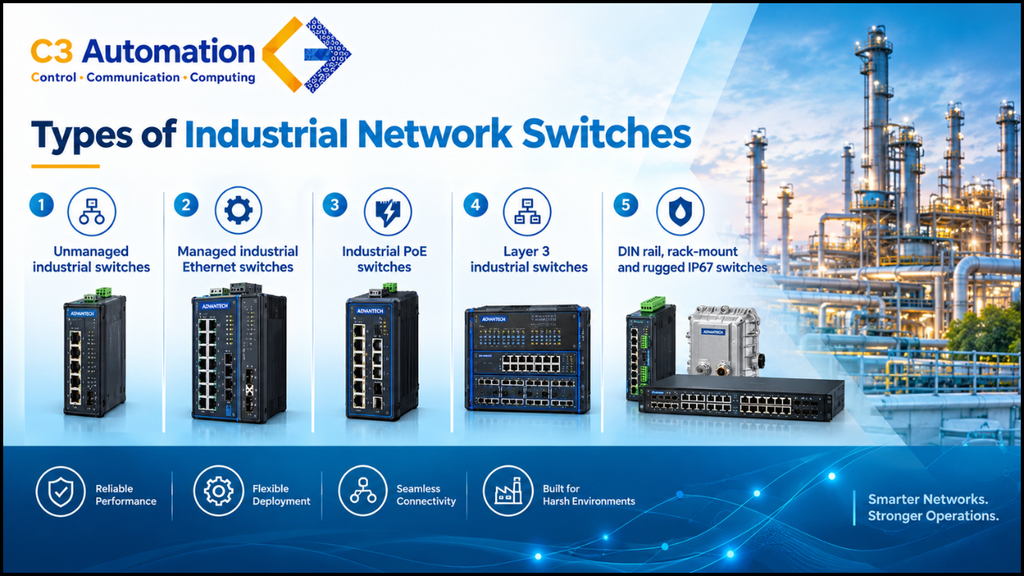
Unmanaged industrial switches
Plug and play, with no configuration and no web interface. An unmanaged industrial switch suits a small machine cell, such as a PLC, an HMI and a few I/O blocks. The trade-off is that you cannot see what is happening on the network, segment traffic or build redundancy.
Managed industrial Ethernet switches
A managed industrial switch lets you configure and monitor the network. Typical features are VLANs to separate control, camera and office traffic, QoS to prioritise control data, port mirroring for troubleshooting, SNMP monitoring, IGMP snooping for multicast protocols, access control and ring redundancy. For anything beyond a small standalone cell, managed is the sensible default, because the diagnostics alone repay the difference the first time you need to find a faulty device.
Industrial PoE switches
An industrial PoE switch carries power and data on one cable, which suits IP cameras, wireless access points, RFID readers and some sensors. Check the standard (802.3af gives about 15 W per port, 802.3at about 30 W, 802.3bt up to 60 or 90 W) and the total power budget, not only the per-port figure. A switch with eight 30 W ports often cannot supply all eight at once.
Layer 3 industrial switches
Layer 3 industrial switch models add routing, so you can split a large plant into zones and route between them without a separate router. They usually sit at the aggregation or core level, and they are common where plant and enterprise networks meet.
DIN rail, rack-mount and rugged IP67 switches
A DIN rail switch clips onto the standard rail inside a control cabinet and is by far the most common form. Rack-mount units suit control rooms and substations. Rugged IP67 switches live on the machine or in washdown areas, with no cabinet at all, at a higher price per port.
Key Features That Actually Matter
Datasheets list dozens of specifications. These are the ones that decide whether a switch survives and performs on site.
Temperature range : Match it to the worst real condition inside the enclosure, not the room. In the UAE, outdoor air regularly passes 45°C in summer, and a sealed cabinet in direct sun can run far hotter. Standard-range switches rated to 60°C leave little margin; extended -40°C to 75°C models give you room to breathe.
Power input : Look for two DC inputs and a relay alarm output, so a failed supply raises an alert before it becomes an outage.
Redundancy: This is where switches differ most. Roughly speaking:
| Protocol | Typical recovery | Where it fits |
| RSTP (IEEE 802.1w) | Hundreds of ms to seconds, depending on topology | General networks, mixed vendors |
| MRP (IEC 62439-2) | Around 200 ms or better | PROFINET rings |
| Vendor rings (for example Turbo Ring, HIPER-Ring) | Often well under 50 ms | Single-vendor rings needing speed |
| PRP / HSR (IEC 62439-3) | Zero recovery time | Substations and critical processes |
Recovery figures vary by vendor, ring size and configuration, so confirm them against the datasheet for your exact model.
Fiber (SFP) uplinks : Copper Ethernet stops at 100 metres. Multimode fiber covers hundreds of metres and single-mode covers kilometres, and fiber is immune to electrical noise and ground-potential differences between buildings. For a large UAE site spread across several plants, fiber is usually the safer backbone.
Protocol support : If you run PROFINET or EtherNet/IP, check that the switch supports the discovery and diagnostic functions your engineering tools expect. Note that EtherCAT normally runs in its own daisy-chain or line topology rather than through a standard switch, so do not assume every industrial protocol simply passes through.
Cybersecurity : The plant network is no longer isolated. Look for port security, role-based access, encrypted management (HTTPS, SSH), logging, and a vendor with a secure development process aligned to IEC 62443. A switch is one layer; it works best alongside segmentation and a dedicated OT firewall.
Lifecycle and support : Ask how long the model will be supplied and patched, how firmware updates are delivered, and who answers the phone when a unit fails at 2 a.m.
Where Industrial Network Switches Are Used
- Manufacturing and packaging : PLCs, drives, vision systems and HMIs on PROFINET or EtherNet/IP. Priorities are low latency, ring redundancy and easy replacement.
- Oil and gas : Remote wellheads, pipelines and refineries. Priorities are hazardous-area approvals (ATEX or IECEx where required), wide temperature range and fiber links.
- Power and utilities : Substations and renewable plants. Look for IEC 61850-3 and IEEE 1613 compliance and PRP/HSR support.
- Water and wastewater: Distributed pump stations over long distances, often mixing fiber and cellular backhaul. Humidity and corrosion resistance matter.
- Transportation : Rail, metro, airports and traffic systems. Vibration, EN 50155 for rail, and PoE for cameras and access points.
- Buildings and infrastructure : Smart building controls, tunnels and car parks, where industrial reliability meets IP camera loads.
Choosing for UAE and GCC Conditions
Gulf sites add a few demands that generic guides skip.
- Heat inside enclosures Specify the switch for the cabinet temperature, and consider shading or cooling the panel as well.
- Dust and sand Fanless, sealed switches avoid the clogged fans that plague open-vent hardware. Use correctly rated glands and enclosures.
- Humidity and coastal air Near the coast, salt-laden air attacks connectors and boards. Ask about conformal coating or a corrosion-resistant housing.
- Long distances Large sites, desalination plants and pipelines call for fiber and carefully planned ring topologies.
- Local support Spares, configuration help and commissioning in your time zone shorten any outage.
How to Choose an Industrial Network Switch: A 7-Step Checklist
- List every device that will connect now, then add 20 to 30 percent for growth.
- Define the environment worst-case temperature, dust, moisture, vibration, hazardous areas.
- Decide managed or unmanaged If you need VLANs, diagnostics or redundancy, go manage.
- Choose speed and media Fast Ethernet or Gigabit ports, copper or SFP fiber, and any 10G uplinks.
- Plan redundancy ring, dual homing or PRP/HSR, and the recovery time your process tolerates.
- Check PoE and power: total budget for cameras and access points, plus dual DC inputs.
- Confirm protocols, security and support: compatibility with your PLC brand, firmware policy, warranty and local service.
A Worked Example
Take a packaging line with 12 PLC and drive connections, two HMIs, four IP cameras and a fiber link to the control room. A sensible build is a managed DIN rail switch with at least 16 ports, PoE on four of them for the cameras, two SFP uplinks, and ring redundancy back to the control room. It costs more than an unmanaged unit. One avoided stoppage normally covers the difference.
Common Mistakes to Avoid
- Buying on port count alone : Two 8-port switches can differ enormously in temperature range, redundancy and diagnostics.
- Filling every port on day one : Leave room for the next camera or drive.
- Mixing office and industrial switches in one ring : The weakest switch sets the reliability of the whole ring.
- Leaving default passwords and open ports : Change credentials and disable unused ports at commissioning.
- Skipping documentation : Label ports, record IP addresses and back up configurations, so a replacement switch can be loaded in minutes.
- Ignoring the cable : The best switch cannot rescue a badly terminated or unshielded cable.
Top Industrial Switch Brands Compared
No brand is best for everything. The right choice usually follows your PLC and engineering ecosystem, your protocols and the support available locally.
| Brand and range | Known for | Typical fit |
| Hirschmann (Belden), such as BOBCAT and RSP | Fast ring redundancy, strong in utilities and transport | Critical networks needing high availability |
| Siemens SCALANCE | Tight integration with PROFINET and TIA Portal | Siemens-based plants and machine builders |
| Siemens RUGGEDCOM | Hardened designs for harsh, remote sites | Substations, rail, oil and gas |
| Moxa EDS series | Easy configuration and wide product range | Mixed-vendor plants, transport, remote monitoring |
| Advantech EKI series | Good value, strong PoE and IIoT options | Cameras, access points, general automation |
| Cisco Industrial Ethernet | IT and OT convergence with familiar tooling | Enterprise-aligned industrial networks |
Check current model names and datasheets before specifying, as ranges change.
How C3 Automation Supports Your Network
C3 Automation is a system integrator in the UAE working across industrial automation, OT cybersecurity and digital transformation. For switch projects, the support typically covers:
- Site assessment and network design : device count, topology, redundancy and growth plan
- Product selection and supply : matched to your PLC platform and environment
- Configuration and commissioning : VLANs, ring redundancy, SNMP and backup of every configuration
- OT cybersecurity : segmentation, firewalls and monitoring around the switches
- Gateways and protocol conversion : connecting legacy equipment such as PROFIBUS to modern Ethernet networks
- After-sales support : spares, firmware guidance and troubleshooting
Trends Shaping Industrial Network Switches
- Time-Sensitive Networking (TSN) : IEEE standards that bring deterministic, scheduled traffic to standard Ethernet, so control and IT data can share a network.
- Single Pair Ethernet and APL : Ethernet reaching down to field instruments in process plants over a single twisted pair.
- Security by design : more buyers now ask for IEC 62443-aligned products, signed firmware and central logging as standard.
- IT and OT convergence : switches that expose the same management and monitoring tools your IT team already uses.
- Private 5G and cellular backhaul : useful for remote assets, with industrial switches at the edge.
Conclusion
Choosing an industrial network switch comes down to matching the hardware to your environment, your protocols and the uptime your process demands. Start with the real conditions on site, plan for growth, favour managed units with redundancy and treat the network as part of the automation system rather than an afterthought.
FAQs
- What is the purpose of a network switch?
A network switch connects devices on a local network and forwards data only to the device that needs it. That improves speed and reliability compared with older hubs, which repeat data to every port.
- What is an IE switch?
IE stands for Industrial Ethernet. An IE switch is an industrial Ethernet switch built for harsh conditions, with features such as fanless cooling, wide temperature range, DIN rail mounting and redundancy.
- Where are industrial network switches used?
In factories, oil and gas sites, power substations, water plants, rail and metro systems, ports, airports and smart buildings. Anywhere machines, sensors and controllers need to talk reliably.
- What is the difference between an industrial and a normal switch?
Industrial switches handle extreme temperatures, vibration, dust and electrical noise, offer redundant DC power and fast ring recovery, and support industrial protocols. Normal switches are designed for offices and are not built for these conditions.
- Should I choose a managed or unmanaged industrial switch?
Choose unmanaged only for small, simple cells. For plants with several devices, cameras, VLANs or any redundancy requirement, a managed industrial switch is the better choice.
- How many ports do I need?
Count current devices and add 20 to 30 percent for growth. Common sizes are 5, 8, 16 and 24 ports, with extra SFP slots for fiber uplinks.
- How long does an industrial network switch last?
With correct installation and temperature margins, many units run for ten years or more. Confirm the manufacturer’s supply and support commitment for the model.