Industrial automation depends on reliable communication. In a manufacturing plant, oil and gas facility, water treatment system or power station, different devices need to exchange information continuously to keep operations running smoothly.
PLCs, HMIs, SCADA systems, industrial computers and other connected devices all depend on a stable communication network. An interruption in this network can affect monitoring, machine coordination and overall plant performance.
This is why selecting the right industrial Ethernet switch is an important part of automation system design.
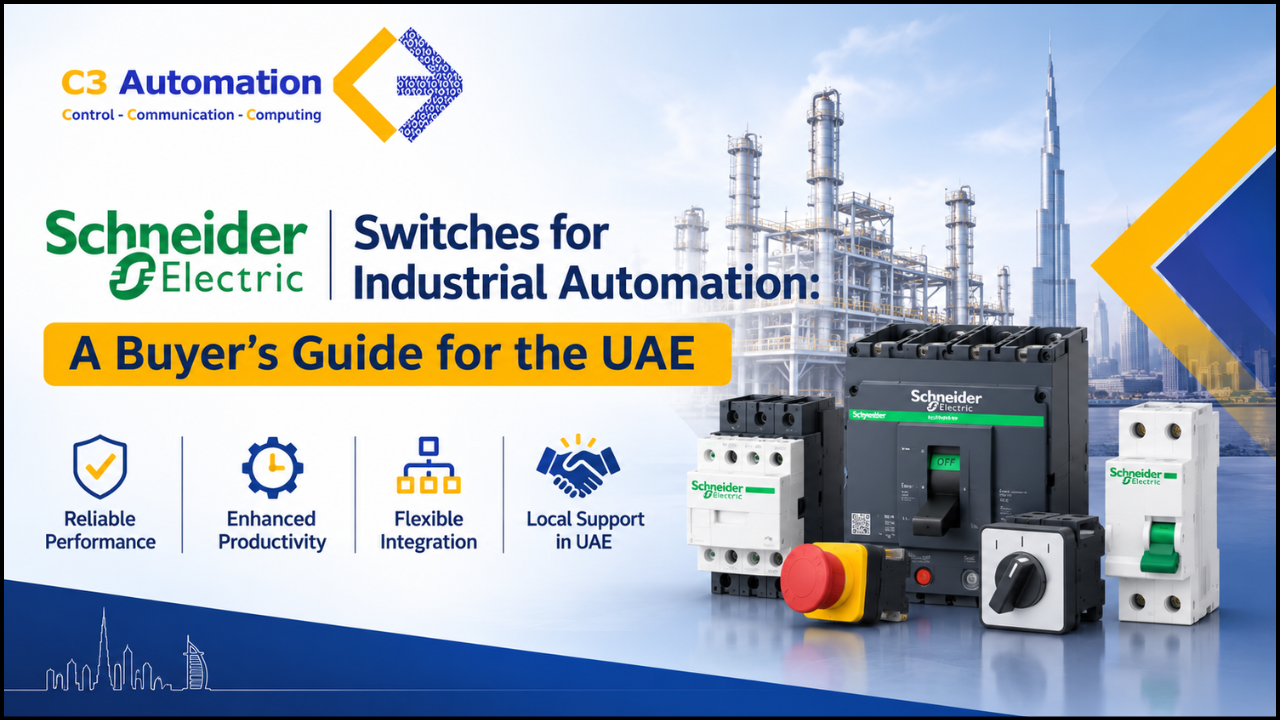
Schneider Electric offers industrial networking products through its Modicon Networking range, including managed and unmanaged Ethernet switches designed for different industrial applications. These products help connect automation devices and support communication across industrial networks.
For businesses looking for Schneider Electric switches for industrial automation in the UAE, understanding the available options and technical specifications can make product selection easier.
In this guide, we will look at the different types of Schneider Electric industrial switches, their applications, important selection criteria and what UAE businesses should consider before purchasing.
What Are Schneider Electric Industrial Ethernet Switches?
An industrial Ethernet switch is a networking device that connects multiple Ethernet-enabled devices within an industrial environment.
Unlike standard office network switches, industrial Ethernet switches are designed with industrial operating conditions in mind. Depending on the model, they may support wider operating temperatures, DIN-rail mounting, redundant network connections and advanced network management.
Schneider Electric’s Modicon Networking portfolio includes products designed to connect industrial devices and support different network architectures.
These switches can be used in communication networks involving:
- Programmable Logic Controllers (PLCs)
- Human Machine Interfaces (HMIs)
- SCADA systems
- Industrial PCs
- Remote I/O modules
- Industrial gateways
- Monitoring and control equipment
The right switch depends on the number of devices, communication requirements and operating conditions of the installation.
Types of Schneider Electric Industrial Ethernet Switches
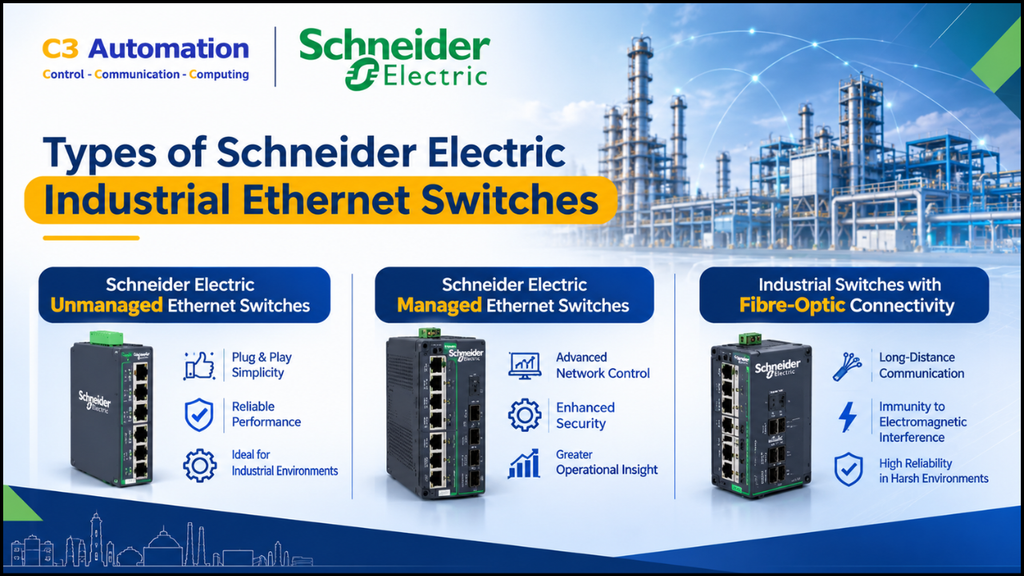
Schneider Electric offers different industrial networking options. Understanding the differences between them is the first step towards selecting the right product.
1. Schneider Electric Unmanaged Ethernet Switches
Unmanaged switches are suitable for basic industrial Ethernet connectivity. They are generally plug-and-play devices and do not require extensive network configuration.
Once connected, the switch allows multiple Ethernet devices to communicate within the network.
Common applications include:
- Small PLC networks
- Individual machine connections
- Basic automation panels
- Simple industrial communication systems
- Small production equipment
For example, a machine may have one PLC, an HMI and a few additional Ethernet devices. An unmanaged industrial switch can provide the required connectivity without unnecessary configuration.
Schneider Electric’s Modicon unmanaged range includes compact copper Ethernet models such as the MCSESU053FN0, which offers five copper Ethernet ports.
2. Schneider Electric Managed Ethernet Switches
Managed switches provide greater control over industrial network communication.
They allow engineers to configure network settings, monitor connected devices and manage traffic according to application requirements.
Depending on the model, available features may include:
- VLAN configuration
- Quality of Service (QoS)
- Network diagnostics
- Port monitoring
- Multicast filtering
- IGMP snooping
- Network redundancy
- Access control and cybersecurity features
Consider a manufacturing plant where several PLCs, HMIs and SCADA systems share an industrial network. A managed switch can help organise network traffic and make troubleshooting easier.
Schneider Electric’s Modicon managed range includes different copper and fibre-optic configurations for industrial networking applications.
3. Industrial Switches with Fibre-Optic Connectivity
Copper Ethernet connections are commonly used within machine panels and control cabinets. However, fibre-optic connectivity can be useful when communication links need to cover longer distances or connect different buildings.
Fibre-optic communication offers several advantages:
- Longer transmission distances, depending on the fibre and transceiver
- Immunity to electromagnetic interference along the fibre
- Electrical isolation between network segments
- Suitability for large industrial facilities
Selected Schneider Electric Modicon managed switches support fibre-optic interfaces and SFP modules.
Before selecting a model, check the fibre type, connector, optical interface and supported transmission distance.
Important Features to Check Before Buying
Not every industrial Ethernet switch is suitable for every application. Before purchasing Schneider Electric networking equipment, review the following specifications.
1. Ethernet Port Configuration
Start by identifying the number of devices that need to communicate through the switch.
Consider connections for:
- PLCs and PACs
- HMIs and operator panels
- SCADA servers
- Industrial PCs
- Remote I/O systems
- Drives and other Ethernet-enabled equipment
Also consider future expansion. Selecting a switch with a few additional ports can make it easier to accommodate new equipment.
2. Managed or Unmanaged Functionality
The choice between managed and unmanaged switches depends on the complexity of the network.
An unmanaged switch may be sufficient for a small machine-level network.
A managed switch is worth considering when the installation requires VLANs, traffic prioritisation, diagnostics, redundancy or more advanced security controls.
For larger PLC and SCADA networks, managed switches provide additional tools for monitoring and managing communication.
3. Operating Temperature and Environmental Conditions
Industrial networking equipment may operate in environments exposed to heat, dust, vibration and electrical interference.
This is particularly important for UAE installations, where high ambient temperatures can affect equipment performance.
Check the following before purchasing:
- Operating temperature range
- Protection rating
- Mounting requirements
- Power supply specifications
- Vibration resistance
- Installation environment
Some Schneider Electric models are designed for severe industrial environments. However, always check the specifications of the individual product rather than assuming all models have the same ratings.
4. Network Redundancy
Network availability is important in applications where communication interruptions can affect production or process control.
Redundancy features help maintain communication when a network link fails.
Depending on the model, Schneider Electric managed switches support technologies such as:
- RSTP (Rapid Spanning Tree Protocol)
- MRP (Media Redundancy Protocol)
- Link aggregation
- Link backup
- HiPER-Ring
The appropriate redundancy method depends on the network topology and the compatibility of connected equipment.
5. Industrial Network Security
As industrial systems become more connected, network security is an important part of automation planning.
Selected managed switches offer features such as:
- VLAN-based access control
- MAC-based port security
- Role-based access control
- HTTPS management
- Port hardening
- Network monitoring and logging
These capabilities can help protect industrial communication networks when properly configured.
For additional protection, businesses should also consider network segmentation, secure remote access, firmware updates and OT cybersecurity practices.
6. Copper and Fibre Compatibility
Check whether the installation requires RJ45 copper connections, fibre-optic connections or a combination of both.
For standard copper Ethernet, the maximum distance is generally 100 metres per segment, depending on the applicable Ethernet standard and cable specifications.
For fibre connections, consider:
- Single-mode or multimode fibre
- Supported optical modules
- Connector type
- Transmission distance
- Network bandwidth requirements
Selecting compatible networking components helps avoid unnecessary installation and communication problems.
Schneider Electric Industrial Switch Models to Consider
Schneider Electric’s Modicon Networking range includes different products for basic connectivity, advanced network management and demanding industrial environments.
Here are some examples worth considering during product selection.
| Model | Product type | Main configuration |
| MCSESU053FN0 | Unmanaged switch | 5 copper Ethernet ports |
| MCSESU083FN0 | Unmanaged switch | 8 copper Ethernet ports |
| MCSESM043F23F0 | Managed switch | 4 copper Ethernet ports |
| MCSESM083F23F0 | Managed switch | 8 copper Ethernet ports |
| MCSESM083F23F0H | Harsh-environment managed switch | 8 copper Ethernet ports |
| MCSESM123F2LG0 | Managed switch | 8 copper ports and 4 Gigabit SFP ports |
| MCSESP083F23G0 | PoE managed switch | 8 Gigabit copper ports |
These are examples from the Modicon Networking product family. Specifications and availability should be checked against the latest manufacturer documentation and UAE supply channels.
Industrial Applications of Schneider Electric Switches in the UAE
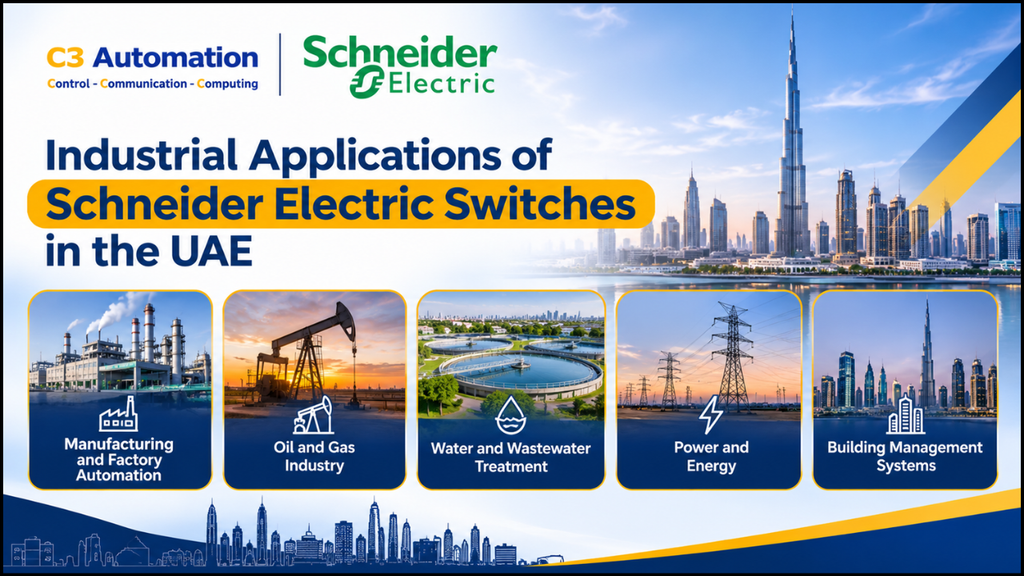
Different industries have different networking requirements. The following examples show where industrial Ethernet switches can support automation systems.
Manufacturing and Factory Automation
Manufacturing facilities use PLCs, HMIs, drives and monitoring systems to control production equipment.
Industrial Ethernet switches help connect these devices and support communication between machine-level and supervisory systems.
Managed switches can be useful when production networks require segmentation, monitoring and redundancy.
Oil and Gas Industry
Oil and gas facilities often depend on automation systems for process monitoring, equipment control and remote operations.
Industrial networking equipment must be selected according to the environmental and operational requirements of the installation.
For these applications, engineers should carefully review operating temperature, network availability, cybersecurity and any hazardous-area requirements.
Water and Wastewater Treatment
Water treatment plants use PLCs, remote I/O modules, sensors and SCADA systems to monitor and control operations.
Industrial switches provide the communication infrastructure connecting these devices.
Fibre-optic networking can also be useful when communication links need to cover larger facilities.
Power and Energy
Power and energy installations depend on communication between control systems, monitoring devices and automation equipment.
The network architecture should account for communication availability, security and the requirements of connected systems.
Building Management Systems
Building Management Systems connect HVAC controllers, sensors, monitoring equipment and other building automation devices.
Industrial networking products may be suitable for specific control-network requirements, depending on the application and supported protocols.
How to Select the Right Schneider Electric Switch for Your Project
Before placing an order, it is useful to prepare a basic networking requirement list.
Step 1: Identify the connected devices.
List the PLCs, HMIs, SCADA systems, industrial PCs and other equipment that need Ethernet connectivity.
Step 2: Calculate the required ports.
Consider both existing connections and future expansion.
Step 3: Decide between managed and unmanaged switches.
Choose according to the level of network control, diagnostics and security required.
Step 4: Check environmental specifications.
Review the operating temperature, mounting arrangement and protection requirements.
Step 5: Confirm fibre and copper compatibility.
Identify the required Ethernet interfaces, cable categories and optical modules.
Step 6: Review network redundancy and security.
For critical automation systems, consider suitable redundancy protocols and security features.
Step 7: Verify the exact model number.
Check the latest Schneider Electric datasheet, product lifecycle status, compatibility and availability before purchasing.
Why Choose C3 Automation for Industrial Networking Requirements in the UAE?
Selecting an industrial networking product is not just about finding a switch with the correct number of ports. Businesses also need suitable technical information, product compatibility and dependable supply support.
C3 Automation has experience in industrial automation, networking and instrumentation, supporting industries including oil and gas, electricity, transportation, water and manufacturing.
Its product and solution portfolio covers areas such as:
- PLCs and I/O systems
- Industrial networking products
- Managed and unmanaged switches
- Network security and firewalls
- SCADA and OPC software
- Industrial PCs and HMIs
- IoT gateways and protocol converters
C3 Automation also provides industrial networking, technical consultancy, installation and commissioning, training and support services.
If you are planning a new industrial networking installation or upgrading an existing automation system, contact C3 Automation to discuss your technical and product requirements.
Conclusion
Industrial networking is an important part of modern automation systems. From small machine panels to large manufacturing facilities, the right Ethernet switch helps establish reliable communication between controllers, monitoring systems and connected equipment.
Schneider Electric’s Modicon Networking range offers different options, including managed switches, unmanaged switches and fibre-compatible networking products.
Before selecting a switch, consider the network architecture, port requirements, operating conditions, redundancy and cybersecurity features.
For businesses in the UAE, working with an experienced industrial automation supplier can make product selection and procurement easier.
FAQs
1. What are Schneider Electric industrial Ethernet switches used for?
They connect PLCs, HMIs, SCADA systems, industrial computers and other Ethernet-enabled devices, allowing them to exchange data within an industrial automation network.
2. What is the difference between managed and unmanaged industrial switches?
Unmanaged switches provide basic plug-and-play connectivity. Managed switches offer additional configuration, network monitoring, VLANs, diagnostics and redundancy features, depending on the model.
3. Which Schneider Electric switch is suitable for a PLC network?
The suitable switch depends on the number of connected devices, network complexity, communication requirements and environmental conditions. Managed switches are worth considering for larger or critical PLC networks.
4. Do Schneider Electric industrial switches support fibre-optic communication?
Selected Modicon managed switches support fibre-optic interfaces and SFP modules. Check the individual product specifications to confirm compatibility.
5. Are Schneider Electric industrial switches suitable for harsh environments?
Selected models are designed for demanding industrial conditions. Always verify the operating temperature, protection rating and environmental specifications of the exact model.
6. Where can I find Schneider Electric industrial networking products in the UAE?
You can explore Schneider Electric products through C3 Automation’s online store and contact its team to enquire about specific product models, availability and technical requirements.